Georeactor Blog
RSS FeedAFK Post February 2026
Random collection of media:
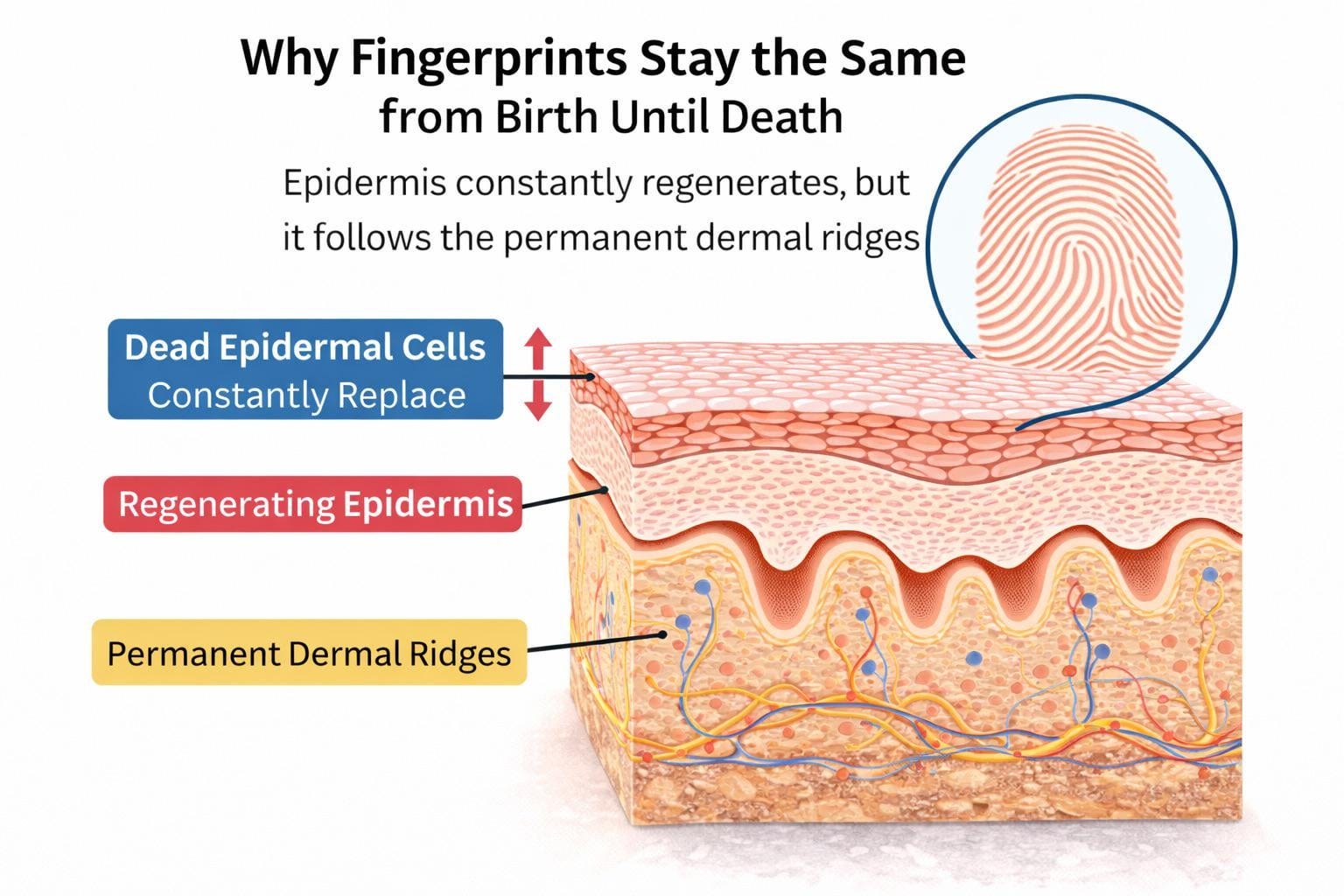
- Notice how this upvoted infographic is almost a real infographic, but the AI is struggling with the wording, the unnatural circle around the fingerprint, and the reflection at the base. The thing which tipped me off though was how this graphic was oddly direct in answering the original question.
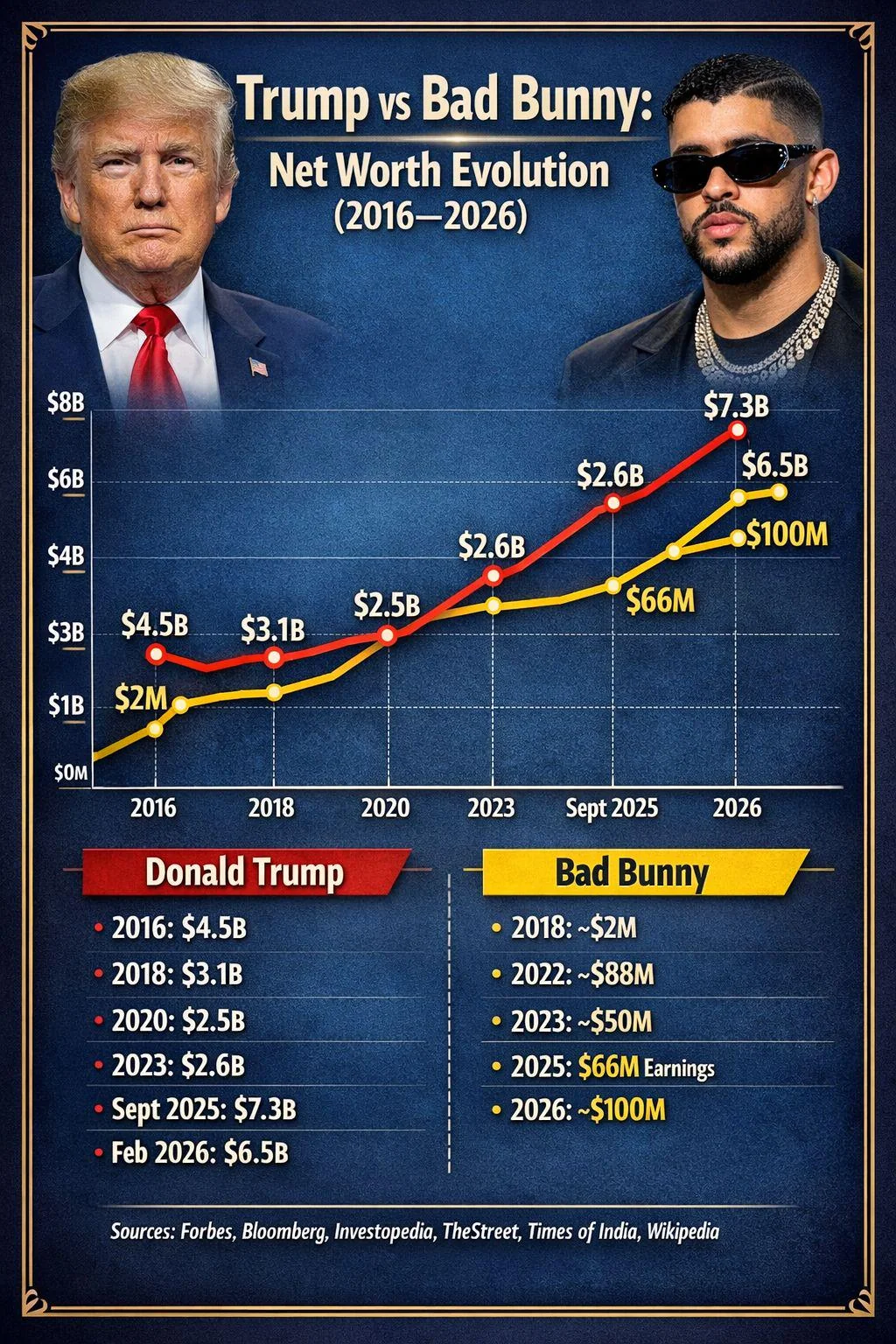
Charts seem particularly challenging to make coherent, which is making /r/DataIsUgly more AI-cluttered and nonsensical by the day:
Maybe Happy Ending announced when the original lead actors will leave. The two understudies for 'Claire' get their own multi-week turns as the character.
On the "Scriptnotes" screenwriting podcast, a write-in and multiple replies describe a compulsion to make lines on a script follow a particular format and not 'orphan' a word on a new line. It was notable that multiple writers experienced this and justified it as beneficial, saying they pay additional attention to lengthen or shorten or revise a line based on this seemingly meaningless rule.
A few people pointed to the sparkle symbols (✨) in the first video of ICE's shooting of Alex Pretti and asked if the video was created or edited by Google Gemini. StreetView shows that the pattern was put in the donut shop window before 2014: https://maps.app.goo.gl/cbyRVCRE73i4VjCn9
From a Wikipedia dive on Ryan Coogler and Fruitvale Station, saw that Oscar Grant's phone was returned to his family 15 years later (in 2024). https://www.nbcbayarea.com/news/local/east-bay/oscar-grant-phones-returned/3461577/
Pleasantly surprised by Doha Debates interviewing an Iranian on the podcast "The Negotiators". I had listened to "The Deal" so I thought I knew everything but it was valuable to have a new perspective. https://foreignpolicy.com/podcasts/negotiators/how-iran-and-the-u-s-found-common-ground-and-lost-it-again/
OTR continued their Indonesia series with the Spice Islands. The capital of Maluku is the city of Ambon, but the real "spice islands" are the tiny Bandas. It's cool that they could look around and set the groundwork for a tour, but as someone who looked up places to solo travel, this assured me that there wasn't one real confluence point that I had missed.
Update on "CyberCorps" cybersecurity students and the federal hiring freeze: https://federalnewsnetwork.com/federal-report/2025/11/how-cybercorps-scholars-are-navigating-a-fractured-federal-job-landscape/
Watched Adaptation. The real orchid guy has an Instagram https://www.instagram.com/therealorchidthief/
I have always thought Apple TV's Platonic looked extremely cringe. After watching over the Christmas break, I agree with a comment that it is a movie concept expanded it into a series (same leads as Neighbors). The female lead is considering returning to work after being a stay-at-home mom, and the male lead is a 'brewmaster'. This feels deliberately designed to zigzag between traditionally masculine and feminine life goals and insecurities. Something for everyone? They also briefly mention young people drinking less, which is the first I've seen pop culture acknowledge this.
Claudette Colvin, who protested the segregation of Montgomery's buses before Rosa Parks, has died. There are several myths about her protest (for the record - she was well aware of the civil rights movement, and was not pregnant at the time of her protest, only during later legal proceedings). BlueSky: https://bsky.app/profile/jeannetheoharis.bsky.social/post/3mcdw2qflcs2v & Wiki: https://en.wikipedia.org/wiki/Claudette_Colvin
Paul Salopek, who is doing the NatGeo "Out of Eden Walk", wrote about police stops including 16 "something like arrest", and persistent surveillance in China. The post links an ArcGIS map which has the most details of his route that I've seen, including gaps: https://outofedenwalk.nationalgeographic.org/papers-please/
Reddit went through a surge of articles about caning in Singapore, of course including the story of Michael Fay. He committed his crime in September 1993, and coincidentally William Gibson's cover story for Wired, "Disneyland with the Death Penalty" was in their September/October issue. Fay's sentencing wasn't until 1994, but I never considered that these two events might have enough overlap to form the current image in American consciousness.
The recent shooting in rural Canada reminded me of the Nova Scotia mass shooting from 2020, and the associated podcast. I learned that the abused romantic partner of the shooter has recently written a book, and did her first TV interviews in January 2026. She is a victim too, and the official inquiry discussed how overlooking her abuse was a systemic failure and part of multiple missed warnings, but the interview was still a controversial move.
Of 20th-century alleged "misconceptions" two things which stick out as extremely controversial are:
- The Spitting Image, a 1998 book which says that hippies spitting on Vietnam vets was a myth mostly invented in the 1980s and spread in the run-up to the Persian Gulf War
- whether most Gen X kids saw the Challenger space shuttle explode on live TV
CNN and NASA were the only sources showing the launch live, so discourse usually starts on whether classes could watch, whether they tuned into the launch live after multiple delays, or if the memories come from replays and news reports on schools that watched the launch (for example McAuliffe's school in New Hampshire). A CNN article from 2016 supports the narrative:
If you were an American kid in 1986, you probably remember exactly where you were: That's because so many classrooms were watching the shuttle launch live via a special NASA satellite feed
But also emphasizes CNN's obscurity at the time:
…the Challenger disaster came as the young cable channel struggled to figure out its mission
[...]
'After this coverage, I rarely had to explain to people what CNN was'
Yet you see a peculiar number of stories where people remember watching live while home sick. An Instagram post claims during 4th grade, they went home alone to eat lunch, watched the shuttle explode on TV, and then walked back to school.
I did some searches on Google's News Archive and Google Scholar. Articles at the time agreed it "may have been the most horrifying live television since Jack Ruby shot Lee Harvey Oswald". In a Boca Raton newspaper article there are accounts of students watching live, but it's memorialized with photos of a classroom watching a replay. One class near the space center is said to have looked out the window and then turned back to the TV when the launch plume wasn't visible.
A few days after the launch, 31–48% of school-aged children reported watching the launch in school:
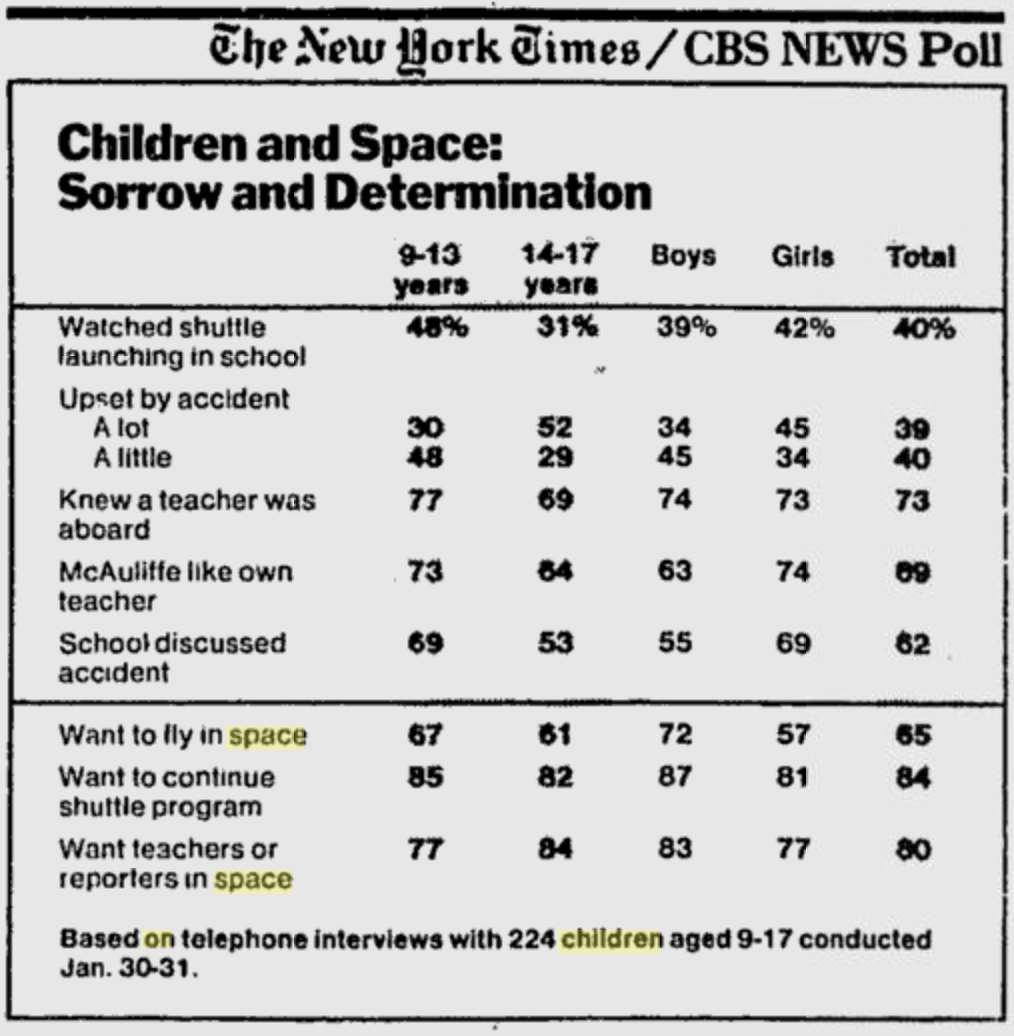
As someone who had heard a lot of "debunking", this seems like a more reasonable middle ground. But most articles -including this survey- didn't make any comment on live versus replayed video. Children might not know or understand that they were watching a recording. The poll shows that >60% did have some discussion at school.
Memory could be compressing how people first learned of the Challenger - an immediate survey of college students found that 20% learned about it from TV, but two years later, twice as many of the same respondents said it was from a TV report.
I wondered if some of this might be affected by depictions in fiction. But Wikipedia lists only more recent shows from the 2020s. In an episode of Mixed-ish, partly informed by Christina Anthony's school story, group of students are depicted watching live in a cafeteria, but also adults gathered at work at an office and an airline.
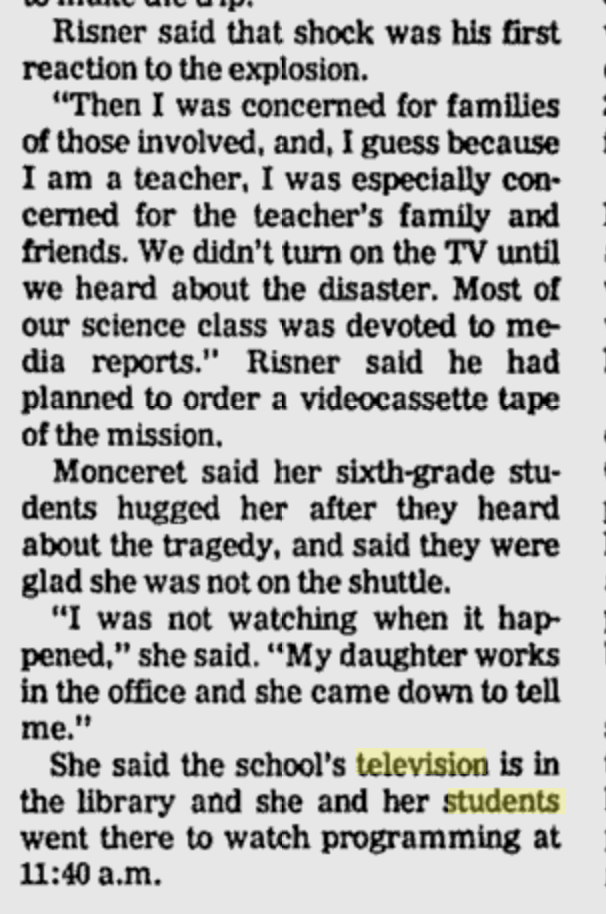
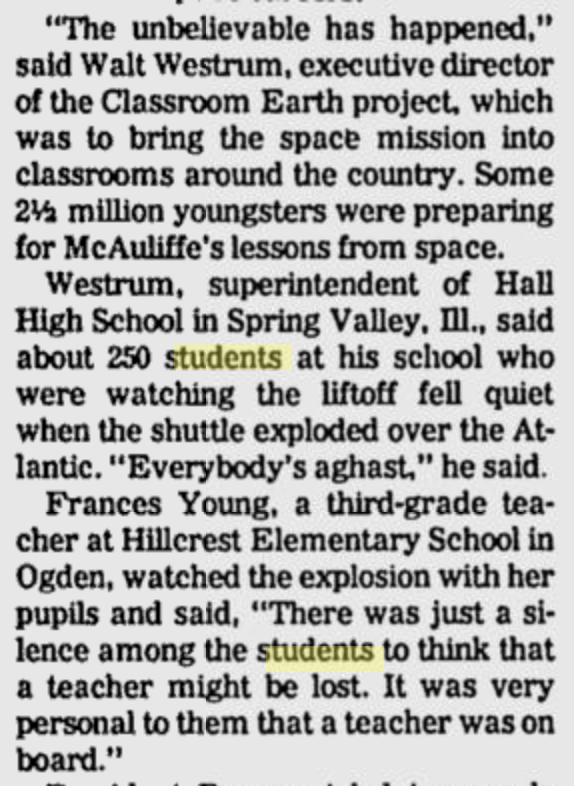
One article interviewed multiple teachers who had applied for the teacher program or expected to take part in McAuliffe's lessons from the shuttle. Two teachers turned on the TV afterward, one going to a TV in the school library. A superintendent at another school describes a group of 250 students watching (enrollment at their high school today and 10 years ago was a bit over 400, so this was likely the majority of students, but not every student).
|
|
It's maybe possible that this reveals a wealth gap between schools with and without TV in the 80s, and the Gen X adults with spare time for posting online today could be from the TV schools?
On 9/11 I did not see any TV until I got home, but a social studies teacher summarized what was going on around midday. We had TV carts and not wall-mounted TVs. I heard about one teacher using a portable antenna TV to get updates when the internet was not functioning. I'm open to millennials' memories of their teachers tuning in during the day, particularly older kids or schools in the NYC area, but the idea that fifteen years earlier every classroom in my town was watching NASA TV feels unrealistic to me.
All this indicates it's a real experience for some Gen X kids, a traumatic memory (even if confused) for most, but also it remains oddly difficult to pin down considering its place in the American experience.
