Georeactor Blog
RSS FeedApril 2026 reads
HHhH (Laurent Binet, 2009; translated by Sam Taylor, 2010)
Binet, a first-time author, tells the story of the assassination of Reinhard Heydrich, a top Nazi official, by agents backed by the resistance in Prague. Binet was already interested in the event when he arrived to teach in Slovakia, and then was rewarded with artifacts and references on visits to Prague. Over the years, through connections, supportive museum staff, and lucky breaks, he gets deeper into the history. This is the meta part of the book. As he tells events chronologically, you know the outline of what is coming, but everything ahead of the current progress of his research is left vague. The last pages leading up to the assassination have a great tension and pacing.
Binet is thinking out loud about how to write the story. Just the facts? Will inventing dialogue paint a picture, or disrupt the historical value? The asides reminded me of The Guest Lecture, though not as frenetic.
Heydrich was given control of Czechoslovakia, where he had a brutal reputation. He and Goebbels were among the first to discuss making all Jewish residents wear a yellow star.
When Binet is talking through the background, he is asking the questions that might run through your head as a kid in school, or now as an adult. What is the source of fascist groups' power? Did Nazis like Heydrich have an evil nature, or was it being kicked out of the Navy and humiliated? If things went differently, would some other Nazi take roughly the same place in history?
Further: what determined who was a resistor and a collaborator? This question is particularly interesting for a French author, compared to an American perspective. Apparently Slovakia is often seen as a collaborator state (rewarded with independence from Czechoslovakia), but the government-in-exile purposely picked one assassin to be Czech, one Slovak. As I was reading in the International Brigades book, it was controversial to attack and risk violent reprisals from the occupiers. In occupied France, the veterans from Spain were quicker to embrace violent resistance. Wikipedia says up to 5,000 Czechs and Slovaks were murdered in reprisals after the assassination. I'll have to pay a visit to the Lidice Memorial outside of Joliet, and next time that I'm in Prague there are a few places.
Given that Binet has great respect for Operation Anthropoid, I thought it was interesting to read his thoughts on the 1993 assassination of French collaborator René Bousquet. He believes that Bousquet's trial might have been a powerful moment for France, and is disgusted that the assassin was looking for attention.
HHhH was Binet's first book. More recently he wrote Civilizations, about Atahualpa invading Europe, and Perspective(s), which does not have an English Wikipedia page, but is a metafiction set in Renaissance Florence.
For modern parallels, a New Yorker profile of Peter Navarro, especially his attempts to teach courses and sell DVDs on China and trade policy, comes to mind.
The Foreign Vocabulary of the Qur'an (Arthur Jeffery, 1938)
Though this was being compiled a century ago for the Oriental Institute by an Australian Methodist minister, this book was a major development in the Anglosphere's knowledge of Islam. It's the first and oldest book listed on Wikipedia's Quranic studies article.
The Quran references Christian and Jewish theology, and traditional histories put Muhammad's tribe, the Quraysh, as globally-connected traders and keepers of the Kaaba, Mecca's pilgrimage site.
I've previously read two books about early Islam by Stephen J. Shoemaker who is a "revisionist scholar". The revisionist school spun out of the 1977 book Hagarism. Over time some claims have evolved, faded, or diversified, but generally these academics argue that the Quran and other core concepts of Islam were compiled decades after the Prophet's death, by followers more familiar with Jerusalem, and that Mecca had only a minor role in pre-Islamic history.
In that context, Foreign Vocabulary is an interesting tour of earlier analyses. Jeffery treats the traditional history as valid - the words in the Quran support that the Prophet was well-traveled and that his community was multilingual. Abyssinian and Jewish communities were believed to be thriving in southern Arabia, and the precise spelling of Biblical names hint that Muhammad learned them from Nestorian Christians. I would describe this as an "Antikythera mechanism" view - the Quran as a time capsule showing that people in the Hijaz 1,400 years ago were smart and had worldly stuff going on.
Foreign Vocabulary dismisses tautologies that the Quran is by definition written in Arabic, or that the foreign words must have originated in Arabic. These words were puzzling even to early Islamic scholars. In the introduction Jeffery says that the Prophet had "a penchant for strange and mysterious sounding words". The author also criticizes prior work for sloppily labeling what they did not understand, often as more distant languages of Abyssinian, Coptic, or Maghrebi (Moroccan and Algerian Arabic).
As someone with minimal knowledge of the language, history, and religion, it is difficult to tell how disconcerting or unclear these 'foreign' words might be in a modern religious context. Browsing the AcademicQuran subreddit, I noticed this comment:
The first century of Islam was a time of rapid linguistic and cultural change for the Arabs
Unfortunately this book is not super readable - it has an introduction and then an alphabetized reference. Possibly because the text includes Arabic, Syriac, Greek, Hebrew, Armenian, and Amharic script, it's hard to find a copy for a good price, and mine was not a great quality print.
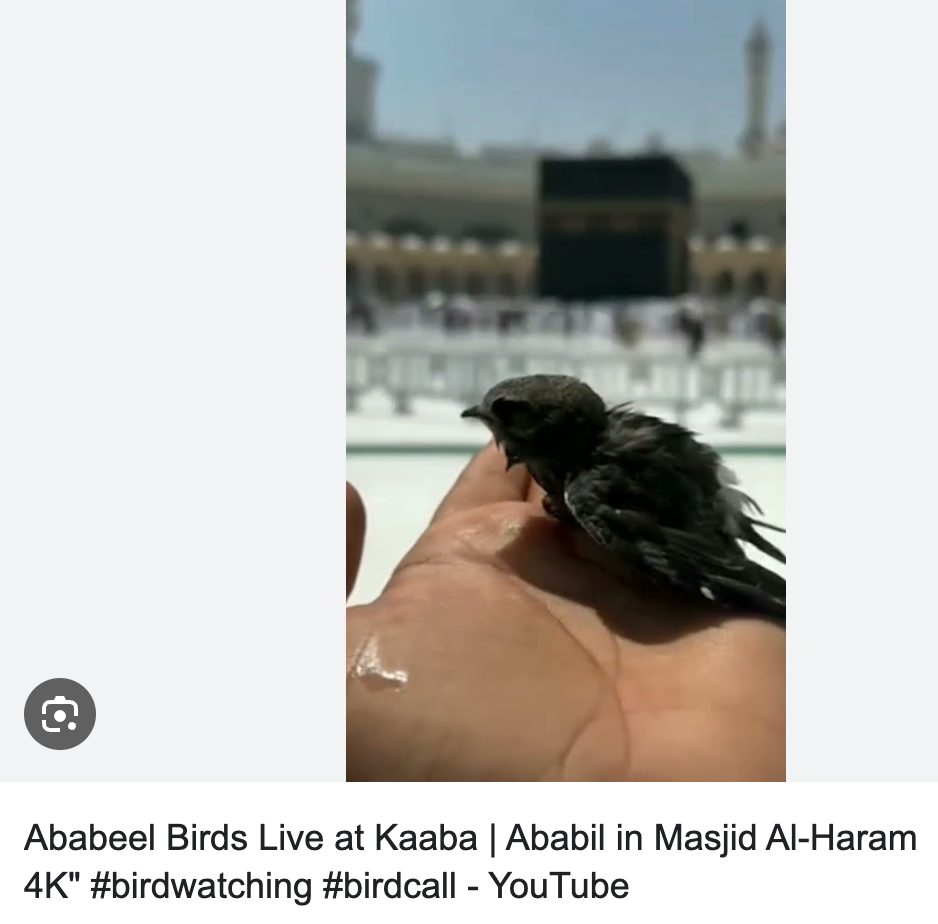
One of the first words in the book is ababil, which Wikipedia will tell you were a flock of birds which dropped rocks to repel the Army of the Elephant from Mecca. Typically the birds are identified as swallows, because they carry dirt to make nests.
Ababil is currently used as a name for a few countries' drones and missiles.
From looking around the internet, it's unclear when people have believed that these were monstrous creatures carrying huge boulders, an unnatural swarm of birds, or just ordinary birds that you can see today.
The entry moves on to alternate interpretations that ababil represents Babylonian arrows (dismissed) or smallpox (promising). The Arabic Wikipedia article mentions smallpox and a herd of camels.
Jeffery finds the smallpox story in the writings of Sir Richard Burton (who did an undercover hajj in 1853) and a German researcher. The Persian word for smallpox آبله (ableh) inspired some Western linguists to make connections, but Burton and Jeffery both ruled it out, at least in that direction. The Persian Wikipedia page for smallpox does not discuss this at all, and their page for ababeel references Foreign Vocabulary.
A social media post attributes the smallpox link to Abū Bakr al-Rāzī, Chief Physician of Baghdad around 900 CE. Al-Rāzī is known for clinically distinguishing smallpox and measles, and he believed that miracles found in the Quran had naturalistic meanings (for related debate, Splitting of the Moon). But an article in WikiJournal of Medicine (bruh) which discusses the smallpox interpretation at length, says "to our knowledge he never mentioned the Elephant War epidemic in his writings".
Some historians don't believe that Abraha came to Mecca or that he could have elephants in his army. They might connect this story to angels repelling an army of elephants in the Third Book of Maccabees (in Orthodox Christianity).
I'd like to say that the book was full of these kinds of rabbit holes. But there is a lot of ink spilled on names from the Old and New Testament. This seems rather obvious, no? I assume that if someone is deep in the weeds enough to pick up this reference book, even in the 1930s, they would be familiar enough with Islam that they aren't surprised. This is particularly troubling when Jeffery includes Allah and aslama (verb form of Islam), just because there's etymology to connect them with other languages in the region. This, and entries where words are described as late additions to Quranic vocabulary, might be hinting toward Jeffery's internal views. First that it is derivative of other religions, secondly that the concept evolved as Muhammad picked up more information, third that Jeffery believes information got distorted through unreliable sources (Goliath entry).
There are entries for theology concepts such as Al-A'raf (a wall, purgatory, or limbo where Heaven and Hell are visible) which get included because their names haven't been found anywhere else. I also don't understand why the book includes words which have been recognized in pre-Islamic Arabic - I assume because they were from one old dialect? Sometimes I think a word is included just for Jeffery to dunk on etymology suggested by another scholar.
Another interesting one: jibt and ṭāghūt. The latter has become the general term for idolatry, so the former is often labeled as an interchangeable word also meaning idolatry. Could it be a specific practice or a specific god? I mean, the Sabians and Hanifs are terms for monotheists which we can't really clarify from the context. The English Wikipedia has one line mentioning that someone interpreted jibt and ṭāghūt to be Coptic Christians and Egyptian pagans. The Arabic Wikipedia spends a lot of time on interpreting jibt as dark magic, but acknowledges the idol interpretation.
NYC trip
I visited NYC. For some reason I didn't document the sights and foods on this trip with as much enthusiasm. I did attend a taping of Colbert's show, the current Broadway revival of Proof with Ayo Edebiri and Don Cheadle, a Transit Museum climate resilience tour, and talks on the WPA and Native American art. Also my first visit to 'the Vessel' in Hudson Yards, the New York Historical (just a block from the AMNH), first time walking across the Queensboro Bridge, and first bagel with salmon roe (at Russ & Daughters).
On Colbert: the show has a month left. Standing in lines was exhausting. He interviewed John Kerry and Neil deGrasse Tyson, and did a segment with Jon Stewart (broadcast the next day). We were quite lucky. The music segment of our episode was recorded several days earlier. We didn't see the writing on Kerry's hand, but we did notice that he was aging. I'd listened to The Negotiators podcast's interviews of US and Iranian negotiators, and thought that they spoke more eloquently about the experience. As Secretary, Kerry might have been more removed from day-to-day negotiation though (I am trying to remember the Kosovo book Collision Course).
Compared to movies, there was a sense that everyone would be in a big hurry to film the show and get it over to the editors. In the monologue, I also thought that Colbert was surprisingly tall (watching from the audience below rather than a camera overhead). Right before the interview someone briefs Colbert, but I don't know how he can hear them over the noise.
On Proof: as soon as I heard that Ayo was doing this, I was already seated (she originated the "I'm simply too seated" meme). Having seen the movie, and maybe with the play's original dialogue, for some reason I just realized that the first conversation between Catherine and Hal is her testing whether he's trustworthy.
In March, the Obamas' company Higher Ground joined Proof as producers. They saw the play a few days before us. I'm not sure how celebrity producers work, especially if you join shortly before performances start. Is it just cash? If Proof wins best revival, that goes to producers, but if it's like the Academy Award for American Factory, it'd go to the company and not the Obamas personally.
Producer credits got renewed attention this year when Spielberg won a Grammy, and he now has EGOT status if you count his producer credit on A Strange Loop with many other celebrities.
Previous Reads
I just discovered that a Vietnamese place in my neighborhood has "Fusion with Jugoslavian" - will try.
I'm baffled by people who are convinced that Anthropic Mythos is hype or vaporware. The way it was written up was very believable. They described some bugs which could be quite serious and have existed in stuff for years.
Read an interesting comment on modern architecture, that the modernism of the 50s-70s had been in designs around in the 30s but wasn't realized until after the Depression, WWII, and recovery. This is why some buildings and art are much older and more "modern" than you'd expect for their time.
GPG has support for a post-quantum algorithm… time to revive AnnealMail? https://lists.gnupg.org/pipermail/gnupg-announce/2026q2/000504.html
Two runners completed a standard regulation marathon (London) in under two hours. This points to modern training and shoes being a significant improvement for performance. Once I was at some business BS event where the speaker said that breaking the four-minute-mile record was more of a psychological barrier, because the record was broken again weeks later. This was a very odd read of the situation: https://en.wikipedia.org/wiki/Four-minute_mile
The Swalwell scandal was embarassing on BlueSky. This got rolled into a false narrative that the Al Franken resignation in 2018 was a big 'oops' from one bad photo, or a media overreaction, or a set-up by Kirsten Gillibrand… when actually it is easy to find that multiple allegations were coming out, and they were following a pattern.
I can agree that, following IMDB, it looks like Al Franken has been un-cancelled enough to appear on TV again in the past 3-4 years, so there's an audience and colleagues are welcoming him back. Compare to James Franco, who is still in the Tár zone (played Fidel Castro in an unreleased Colombian movie).
Saw R. F. Kuang's book talk. The Chicago Humanities festival is a little awkwardly in between books. The majority of the audience had read Katabasis, but she's also signing and selling copies, so it wasn't suitable to give spoilers. Taipei Story will be out in September. Kuang talked about Letterboxd as her ideal social media environment, trusting in Gen Z students who have pulled back from the internet (location of future teaching job uncertain), how society allows some "geniuses" to get away with anything (e.g. Kanye), and researching "aesthetics of fascism". I interpreted this last part to be a combination of: who gets drawn to it in which eras, and also the literal aesthetics of uniforms and architecture. Having read HHhH I think it is possible to do this, but it is a delicate thing.
