Georeactor Blog
RSS FeedLianda and the Long March
In 2018, former journalist Yang Xiao walked 1,000 miles from Changsha to Kunming. He was following a trek taken by hundreds students and a few adventurous faculty of three elite Chinese universities in 1938. In the face of the Japanese invasion, they united into one school (Lianda, 臨大, a shorthand for Provisional University) and moved their campus deep into the mountains of southern China.
They climbed mountains, crossed rivers, and sometimes slept side by side with coffins-even spending the night in a supposedly haunted house. They woke up at dawn and slept late, sometimes seeing off the threat of bandits in between. They sang, danced and played cards. One student, Liu Zhaoji, collected more than 2,000 folk songs along the way, and another, named Zha Liangzheng, would tear the page out of an English dictionary after he had memorized its content.
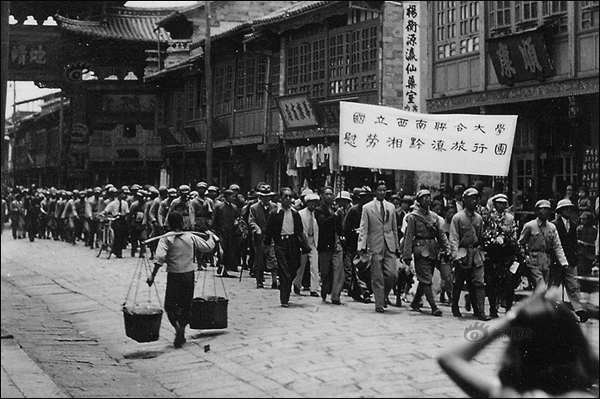
Photo from Wikipedia
When I first read about the journey, my only reference point was Mao's Long March a few years later. I wondered if that could be the inspiration? Instead, the common thread appears to be advances in technology and roads. Mass movements could now hire a few trucks to carry supplies and injured marchers, and buses over a few steep and snowy stretches, but there were not yet enough vehicles or reliable roads to carry hundreds of travelers continuously from start to finish.
Another wartime march took middle school students ~260 miles from Xi'an to Tianshui.
Just a few years later, the Japanese army's use of bicycle infantry in Malaya would be seen as cutting-edge.
In some ways the student march was seen as a patriotic action, and a way for urban, Han Chinese students to engage with rural communities over ~70 days. In a section maybe foreshadowing the Cultural Revolution, professors at both ends of the political spectrum believed that the students should do some national service in the countryside.
Young women at the schools and most faculty took a more conventional route, but found themselves traveling alongside other refugees through multiple ship and rail links (through Hong Kong or Hanoi). This was fraught with its own difficulties, and the route would be cut by the Japanese in 1941-42.
While Chiang Kai-Shek's government moved to Chongqing, and Mao's army was in Yan'an, the combined university would try to hold on through the bombs of one war and the upcoming rumblings of the next.
Why I was reading about Lianda
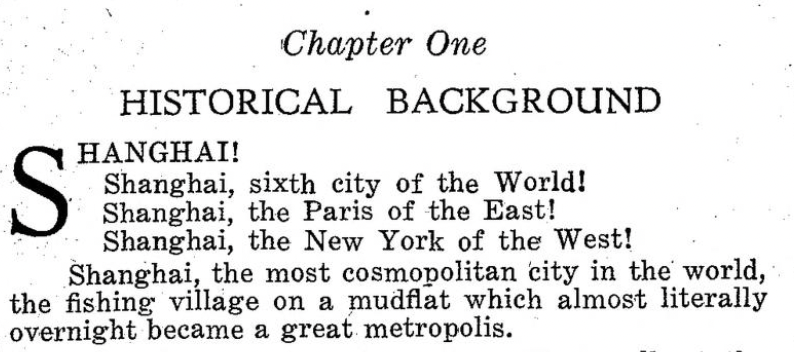
After reading about W. E. B. Du Bois's visit to Shanghai in Arise Africa, Roar China, I wondered if pre-war Shanghai had a place as a lost ideal cosmopolitan center, like 'Paris in the 20s'. The Wikipedia article on "History of Shanghai" says as much: "The Paris of the East, the New York of the West". The phrase originated with the travel guide, All About Shanghai and Environs. Same vibes as how people like to talk about Shenzhen today:
During this research I stumble on the story of Lianda as an intellectual meeting point. From Wikipedia at the time (removed due to NPOV):
Lianda became famous nationwide for having and producing many of China's most prominent scientists and intellectuals, including the Nobel Prize laureates Yang Chen-Ning and Tsung-Dao Lee
The go-to book on this, in both the 2018 article and some sources in the English-speaking world, is Lianda: A Chinese University in War and Revolution (John Israel, 1998). The book received a surge in popularity after a Chinese translation became available in 2012 (most GoodReads reviews are in Chinese).
Highlights from the book
China's three leading universities evacuated from Beijing and Tianjin in 1937. They spent one year in Changsha, where (pre-Pearl Harbor) a US flag would deter Japanese air raids. The art college campus was "a wonderful society of philosophers, writers, and scholars, all in one building." When Changsha fell within range of attacks, that began the march to Kunming.
Lianda was successful in combining the distinct cultures of each major university. This was a pivotal time for professors to consider maintaining Chinese values or embracing Western academia as modernization. An example would be the imposition of a final exam, which Lianda agreed to conduct but not grade.
The author mentions another wartime university "Xibei Lianda" established in the northwest, which failed in this tumultuous environment.
The conditions in the retrofitted buildings sound appalling, and wartime inflation stretched students' and professors' budgets. There were months when the Japanese would do air raids on any clear morning, mandating the careful scheduling of meals and classes.
The Nationalists initially did not press professors and students into wartime or patriotic education. Over time the regional government and education ministry shifted their attitudes, and students were required to take courses and attend speeches on Chinese values (particularly Sun Yat-Sen's Three Principles of the People). Students did their best to avoid these, and the author found only two who faced significant consequences over it.
In the middle of the book we get a profile of each academic department, with a mini bio of notable professors. Any one of these could be a rabbit hole, such as polyglot Chen Yinke whose opposition to Simplified Chinese characters was honored by publishers until 2020. Political scientists and sociologists took an interest in their new surroundings in Kunming / Yunnan Province, and so did the sciences of biology and geology. The province was going through a teacher shortage, and badly needed Lianda's education school. Other science courses struggled to find lab equipment (though two alumni did win the Nobel Prize in Physics in 1957), and classical historians did not delve into their new community.
Robert Winter, an American professor of English, gets a mention in the book, but his full story may have been lesser-known during the author's research. After Lianda he would be caught up in the civil war and then the Cultural Revolution - in 1971 there's a mention in the New York Times: "He recently returned to the Peking campus […] after months of rigorous re-indoctrination at hard labor undergone with other faculty members on a collective farm".
After rumors of Winter's long history in China reached his alma mater in Indiana, English professor Bert Stern paid him a visit in 1984. Decades later Stern published his research in a book Winter in China: An American Life - this article is haunting:
One of the first things the old man said to me after he'd roused himself was, "Can't you think of some way to get me out of here?"
He would die in Beijing in 1987.
Based on some reading, Winter may have fled the US in the 1920s after "a homosexual indiscretion", and chosen China for political ideology or obscurity. Lianda does hint at a few professors' social lives, including a comment which I interpreted as queerness through 1940s discretion and 1990s history book filters.
Lianda's role in China's future education and politics?
At some point, as a reader I went from seeing this as a biography of a university keeping afloat during wartime, to questioning whether Lianda met the moment. China was about to fall into civil war and the difficult early years of Maoism. Just thinking about education, every curriculum was about to be rewritten. Sociology, for example, would be banned from campuses from 1952-79.
Dr. Israel found only one philosophy course that was taught on Marxism, and the Communist Manifesto was covered only in an English class late in the war. Though the faculty successfully alienated an outspoken, literally rat-eating fascist, other professors taught eugenics or were known for being "incomprehensible". My overall sense was that most professors leaned towards centrist or right wing politics, but recognized the corruption of the Nationalist government. Maybe this is unsurprising as the faculty who made it to Lianda had not jumped ship to support either side.
Students were politically active in posters and, notably, in performances on campus and in nearby communities. From when I did a video on the Taiping Rebellion - these political plays and historical dramas shaped both leaders' and common people's understanding of their past and Mao's revolution. The author contrasts a failed KMT lecture with a successful performance by communist students, who learned Yunnan's dialect and visited homes afterward. Divisions and sabotage of a performance at Lianda required the mediation of a professor whose credentials included being future-premier Zhou Enlai's drama teacher (an online source agrees "As a middle school student, Zhou loved acting in plays").
Leftist activism was muted after the New Fourth Army Incident in January 1941, a battle between KMT and Communist units. In 1942, some American pilots would relocate to Kunming and increase demand for translators and English classes. But by the time that US VP Henry Wallace visited the US base and Lianda campus, he noted the professors' sympathy for communists. In the final pages the author covers Chiang Kai-shek's firing of the Yunnan governor Long Yun in late 1945, which led to strikes and four deaths in clashes with police. In the spring of 1946, with trouble on the horizon, the universities returned to their original campuses.
Notes
Today a high-speed rail trip from Changsha to Kunming takes around five hours.
The author of this book, Dr. John Israel, arrived in Taiwan in 1959 and learned Chinese history from John King Fairbank at Harvard. Fairbank served with the OSS in Chongqing, and McCarthy blamed him for losing China; the AskHistorians subreddit is decidedly post-Fairbank. In 1973 Dr. Israel started the journey toward this book by attending a Lianda alumni meeting in Taiwan. He visited Kunming for the first time in 1980.
After retiring from UVA in 2003, Israel continued to teach in Kunming and international exchange programs.
In a 2018 article in The Globalist, the author describes his Kunming apartment being taken by eminent domain and an intimidation campaign. A year later he was continuing to discuss Lianda in China while working on a book about the Red Guards.
The most recent mentions of him online are a conference transcript in May 2020, and his Red Guards book Finding China's Lost Generation getting published in 2023.
Videos about Lianda
News story about a 2021 documentary: https://www.youtube.com/watch?v=OkwswCEVw74
News report in 2025: https://www.youtube.com/watch?v=V4V4PX1ykto
